
Re7 Launches The ETH Yield Strategy with Optimism
Re7’s ETH Yield Strategy, Anchored by Optimism: A New Way to Think About ETH
Re7 is pleased to announce that it is joining forces with the Optimism Foundation to launch the ETH Yield Strategy. Most institutional ETH sits idle, earning nothing. The ETH Yield Strategy is a market-neutral strategy designed to change that, putting ETH to work across leading DeFi infrastructure with the objective of accumulating more ETH over time regardless of price direction. The current landscape represents one of the most compelling ETH yield environments we have seen in recent years. The strategy is suited to digital asset treasuries, custodians, and opportunistic yield-focused allocators managing ETH at scale.
The Optimism Foundation Relationship
For institutional allocators evaluating onchain yield, the question of who else is in the room matters. The Optimism Foundation has engaged Re7's ETH Yield Strategy as a primary source of yield across its ecosystem, an arrangement that introduces a layer of institutional validation that traditional fixed income markets cannot replicate.
The arrangement gives the ETH Yield Strategy access to native incentive structures tied to real ecosystem growth on Optimism, distributed through genesis liquidity provision. These incentives are denominated in assets additive to the core ETH strategy, and are accessible through regulated, institutional-grade infrastructure. Re7 established relationships across the Optimism ecosystem underpin the operational execution of this allocation.
Re7 and the Optimism Foundation are channelling institutional liquidity across the DeFi ecosystem, supporting industry growth and strengthening the infrastructure that underpins it. This is not a passive arrangement. It reflects Re7's track record as an active operator and builder across blockchain ecosystems, a capability that differentiates the firm from allocators who simply access yield passively through public protocols.
How the Strategy Works
The ETH Yield Strategy is executed via a market-neutral approach. The core allocation is a leveraged staking loop: ETH is staked into liquid staking tokens, deposited as collateral on third-party lending venues, and the spread between staking yields and borrow costs is captured at scale. This core structure accounts for approximately 70 to 80% of deployed capital.
The leveraged staking loop is structured around the difference between what staked ETH earns and what it costs to borrow against it, a spread that has remained durable across market conditions. The resulting exposure is driven by borrow-rate variability rather than asset price direction.
Supplementary tools complement the core: unleveraged lending, restaking delegation, DEX liquidity provision, stablecoin deployment, and selective special situations including genesis liquidity and basis trades. These are additive in nature.
Outcomes are denominated in ETH and accrue through capital deployment and protocol mechanics, not price direction.
"Institutional allocators have had limited options for putting ETH to work within operational and risk constraints. The ETH Yield Strategy changes that, combining market-neutral yield with the infrastructure and oversight institutional clients require.
For digital asset treasuries and custodians, it enables a shift from passive ETH exposure to active yield distribution, meeting growing demand from opportunistic, yield-seeking capital.”
Evgeny Gokhberg, Founder, Re7
What the Data Shows
Re7 has managed live DeFi yield strategies continuously since 2021, accumulating over 4 years of operational track record. The chart below shows annual returns of the Re7 Liquidity Strategy from inception through to 2025, net of costs and gross of management and performance fees.
Re7’s Liquidity Strategy Performance
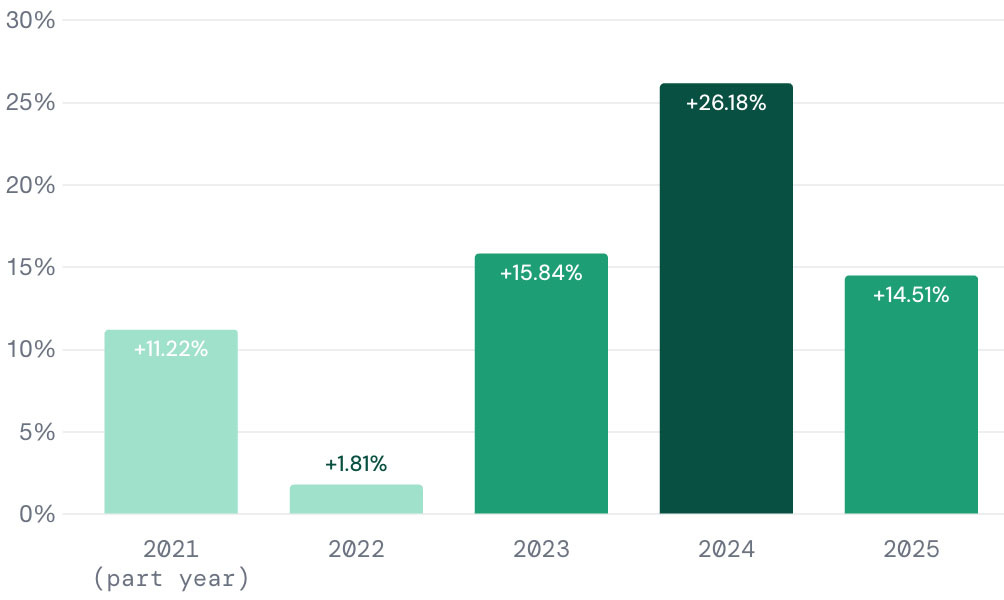
Figures reflect the historical performance of Re7 Liquidity Strategy. Performance after strategy costs; gross of management and performance fees. 2021 reflects a part year (Jul-Dec). Past performance is not indicative of future results.
The ETH Yield Strategy is a distinct, new product. The strategy below, built around the core leveraged staking loop, has been backtested by applying historical data to its specific mechanics.
The ETH Yield Strategy Backtested Performance
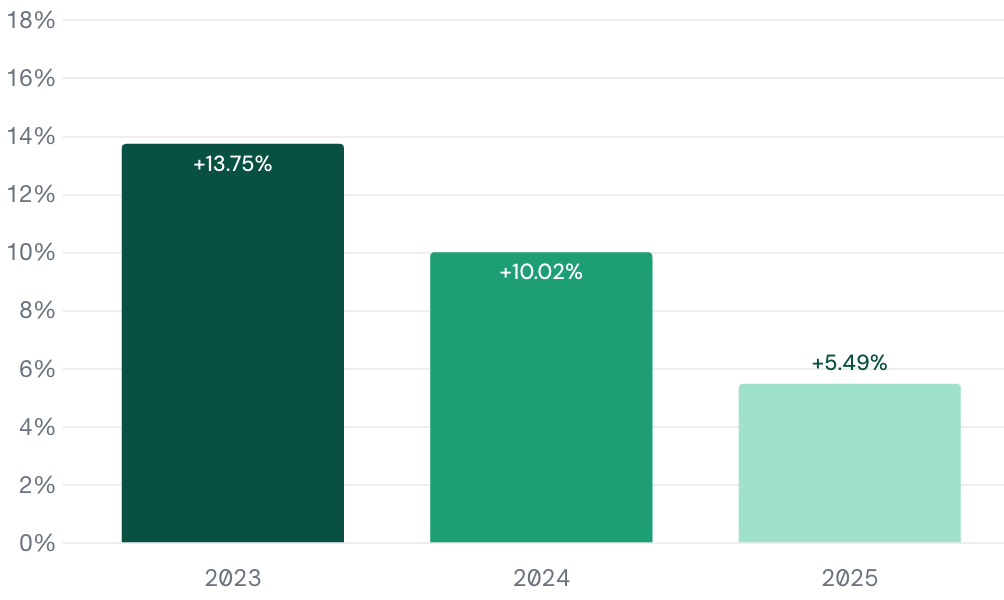
Backtested figures are hypothetical and do not represent actual performance. Derived by applying historical data to the core leveraged staking strategy. Supplementary yield sources are not fully captured in the backtest. Should not be relied upon as an indicator of future results.
Those figures represent a conservative view. Supplementary yield sources are not fully captured in the backtest, and leverage and pool allocation can increase as the staking-borrow spread widens.
Risk Management
For institutional allocators, yield is only part of the equation. The ETH Yield Strategy is structured accordingly.
Allocation decisions are governed by an Investment and Risk Committee. The Re7 Risk Engine scores counterparties including smart contract risk, economic risk, governance, liquidity, and KYC/AML, with single-asset limits. The current portfolio is concentrated in AAA and AA-rated protocols.
Strategy Structure
The strategy is open-ended. A three-month minimum hold is recommended, reflecting the time needed to benefit from economies of scale and optimal position management.
The strategy is tokenised via Midas. Access here: https://midas.app/mre7eth
Disclaimer: This article is for information purposes only, and is intended for professional or institutional audiences. Nothing herein constitutes, or should be construed as, a recommendation, offer, solicitation, or endorsement of any financial product, service, or transaction, including any interest in products offered or advised by the author(s) or their affiliated entities, nor does it constitute investment advice or a financial promotion in any jurisdiction. The information is provided as is, without any representation or warranty as to its accuracy or completeness. Recipients should conduct their own independent analysis and seek advice from qualified professional advisers before relying on this information. Any such reliance is strictly at the recipient’s sole risk. To the fullest extent permitted by applicable law, the author(s) and any affiliated entities disclaim all liability for any loss or damage arising directly or indirectly from the use of, or reliance on, this article.